
Resident Lookup Records in Allegheny County
An official record rarely answers every question about one person. The county real estate search is keyed to an address or parcel, not a name-first household search. It can return the assessed owner, parcel details, and an address, but it does not establish who occupies a place. Court and vital records may help separate people with the same name. Use each source only for the fact it actually records, then compare stable details such as an initial, a filing date, a docket number, or the legal description of a parcel.
| Record | Confirms | Where | Access |
|---|---|---|---|
| Assessment record | Assessed owner, parcel, and listed address | Allegheny County Real Estate Portal | Address or parcel keyed |
| Public court docket | Named party and case activity | Pennsylvania UJS Portal | Public docket types only |
| Court division record | Civil, family, criminal, or estate case material | Allegheny County court records | Division and case access vary |
| Marriage or historic vital index | Event, index entry, or license route | Pennsylvania State Archives | Copies and eligibility differ |
| Credential or entity filing | Professional credential or business connection | PALS or the state entity search | Not a home-address source |
Start with the most reliable piece of information already in hand. An address or parcel belongs at the county assessment search. A court case number belongs at the court source. A documented marriage, death, or estate question belongs with the office that keeps that event. This sequence keeps a resident lookup tied to the record rather than to a broad name match.
Using Allegheny County UJS Resident Lookup
The public side of Pennsylvania's Unified Judicial System portal includes appellate, criminal Common Pleas, Magisterial District, and Philadelphia Municipal docket sheets. It does not provide ordinary Common Pleas civil dockets. That limit matters when a name appears in a search result, because an absent result can reflect the portal's scope rather than the absence of a court record. The county Department of Court Records separately handles Civil/Family, Criminal, and Wills/Orphans matters.
For a name search, choose Participant Name and narrow it before reviewing results. The available fields let a researcher select Allegheny as the county, enter last and first name, and optionally add date of birth, a date-filed range, docket type, and case status. An initial or a date window can be the difference between a usable record set and a long list of unrelated people.
| UJS field | Use | Format or choice |
|---|---|---|
| County | Limits the search area | Choose Allegheny |
| Participant name | Finds a named party | Last name and first name |
| Date of birth | Helps distinguish same-name parties | Optional |
| Date filed | Constrains a known time period | Optional range |
| Docket type and status | Reduces unrelated case types | Optional selections |
Note: Match a court record with its docket number and filing date before using it to distinguish two people with similar names.
Reading an Allegheny County Resident Docket
A public UJS result typically identifies the Docket Number, Court System, Case Caption, and a Docket Sheet link. The caption can place two names together in one case, but it is not an address record. The docket number, court system, and date are better controls for later checking. Record those details before opening the docket sheet, especially where a common surname produces several candidates.
The county's Department of Court Records has a different path for court divisions. Civil and Family records are public unless sealed, and its automated records begin January 3, 1995. Earlier written dockets require the counter or written-record route. Criminal and Wills/Orphans material is handled through their respective divisions. A DCR login is for a known case or case ID, not an unlimited people search.
A docket is the court's running case record. An index points to a record, while an image is a view of the underlying document when one is available. A certified copy is a copy issued by the record custodian with its certification, and it is the version to request when a formal record is required.
- Docket Number: the identifier that ties later checks to one case.
- Court System: the court category that produced the record.
- Case Caption: the names used to label the case.
- Docket Sheet: the event list and filings available for that public matter.
The public UJS case-information entry point distinguishes public and secure access before a docket search begins.
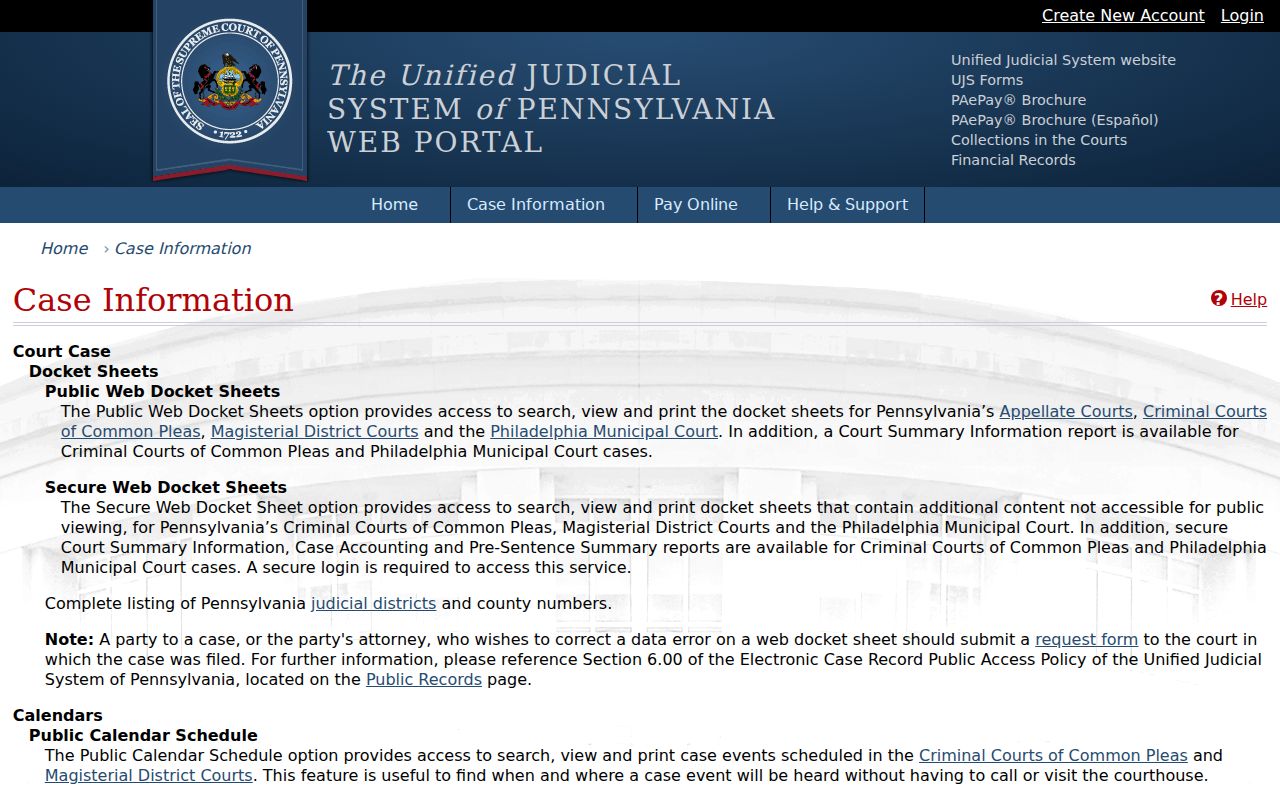
That public-versus-secure split is a reminder to use the appropriate official channel instead of assuming every court record is searchable by name online.
Confirming an Allegheny County Resident
Use a controlled sequence when the goal is to confirm that records describe the same person. A property result may give a parcel and assessed owner. A public court record may provide a dated case reference. A marriage, death, or estate index can add a separate event trail. None should be stretched into proof of a current household. Keep a short record log with the source date, the exact name form, and the record identifier.
- Anchor the name to a documented address or parcel in the county's address-keyed assessment search.
- Search the UJS Participant Name option with the county, first and last name, and a narrow date range when known.
- Compare initials, dates, docket details, and the parcel legal description before treating records as one person.
- Use the relevant custodian for a court, marriage, vital, or estate copy when the available index cannot settle the question.
Same-name controls are simple but essential: retain the exact name form, source date, court and docket, and parcel legal description. A name alone is not a safe bridge between an assessed owner, a case participant, and an index entry.
Vital Trails for an Allegheny County Resident
Pennsylvania births and deaths from 1906 forward are held under state rules. Section 801 makes birth records public after 105 years and death records public after 50 years. The State Archives historic indexes cover births from 1906 through 1913 and deaths from 1906 through 1968. A birth certificate is not an open name-search tool: the state charges $20 and applies eligibility and identification rules to a certificate request.
Marriage licenses are a more direct county route. Allegheny County Wills/Orphans holds licenses from 1885 forward. The online search and order route covers 1996 forward; older licenses use the office's order route. A plain, non-certified copy costs $4, with a $4 search fee. When looking for an heir, begin with Wills/Orphans, the estate record, recorder material, and an obituary rather than trying to force a vital record into a general resident lookup.
PAIR is Pennsylvania's authorized adoption route. It is not a generic name-lookup service. That boundary protects people whose records have a special access process.
Court Access for Allegheny County Residents
A known Common Pleas civil, family, criminal, or estate matter may require the county Department of Court Records instead of a statewide name result. Civil and Family records are public unless sealed. The department's automated records begin on January 3, 1995; earlier written dockets follow the counter or written-record path. Keep the case caption, division, and date together when contacting the correct office, since these identify the record without turning a known-case request into an open-ended name search.
The DCR system has separate Civil/Family, Criminal, and Wills/Orphans divisions. Its login is tied to a known case or case ID. It cannot be used as a substitute for the UJS Participant Name search, and the UJS portal cannot supply the ordinary Common Pleas civil dockets outside its public product.
Checking Allegheny County Resident Voter Status
The state voter-registration-status form is designed for a voter to check personal registration status and polling information. It is not a public browse-by-name roll. Pennsylvania's formal statewide list is governed by Election Code certification rules, so a resident lookup should not imply that the status form can reveal another person's registration record.
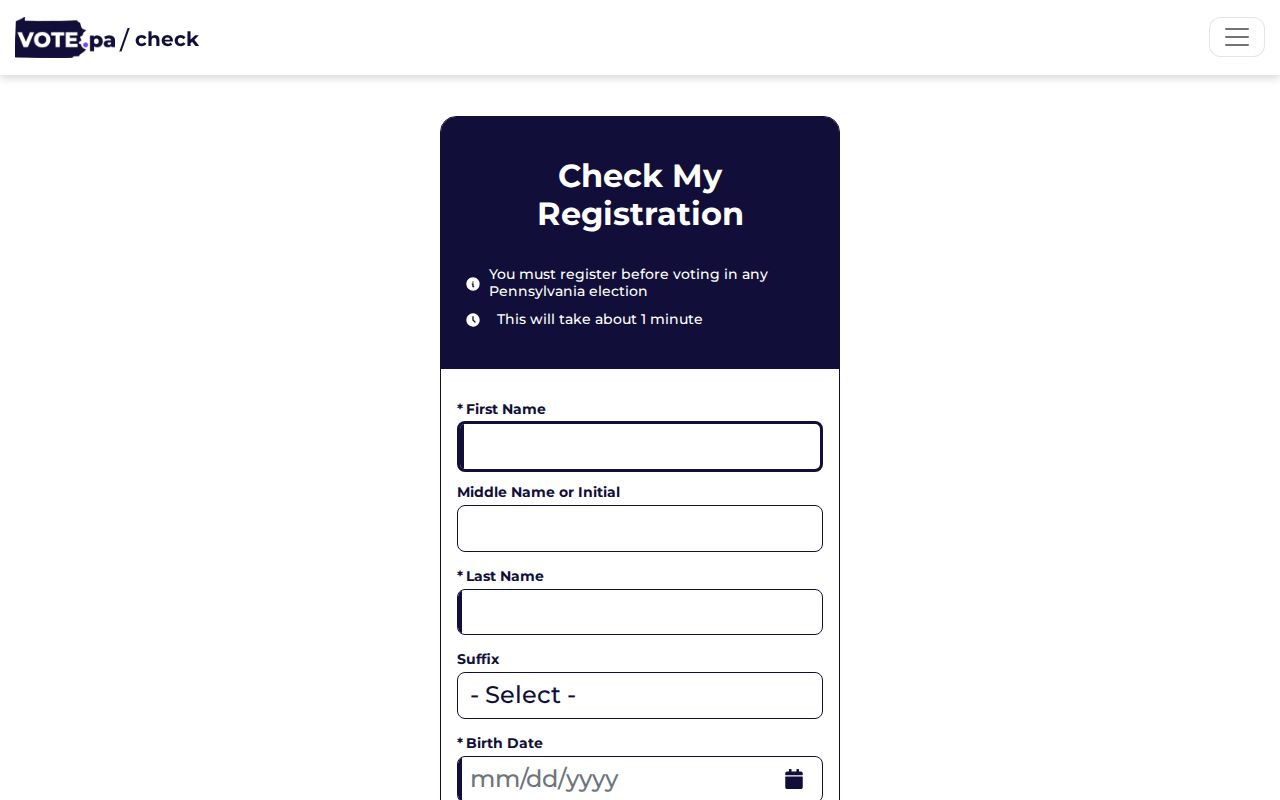
The form's personal status purpose is clear at the official entry screen. Use it as intended, and rely on formal election-office procedures when a request requires an authorized list.
Credentials for an Allegheny County Resident
A Pennsylvania credential search through PALS can corroborate a professional license. The Department of State business entity search can corroborate an entity relationship. Neither is designed to identify a private home or establish present residence. Treat each as a narrow check on a credential or an organization, then return to the record source that actually documents the fact in question.
[HUMAN USE] When family research points to a possible heir, an estate case, recorder entry, and obituary can form a documented trail without turning a credential or corporate filing into a personal-address search.
Limits on an Allegheny County Resident Lookup
Some records are excluded from public UJS search: juvenile matters, Common Pleas civil matters in that product, expunged or pending-expungement cases, sealed records, Act 5 limited-access cases, and destroyed records. A no-result response cannot prove that no record exists. It may instead show an access limit, a different court division, or a record that must be requested through the custodian.
Pennsylvania's Address Confidentiality Program permits a substitute address. Actual addresses, applications, and waivers are confidential under 23 Pa.C.S. §6703(d). Do not attempt to work around that protection through linked records, name variants, or address history. Ask the office holding a record how to correct an error in its own data.
[MYTH] A property owner name, court caption, or indexed event is not proof of a current household. Corroboration requires matching record-specific facts and respecting the records that are deliberately closed.