
Finding Allegheny County Residents
Allegheny County does not publish one roster of everyone who lives here. Instead, each record answers one limited question. The Real Estate Portal starts with an address or parcel and reports the assessed owner. The Department of Real Estate index ties parties to recorded land transactions. A historic directory may show a printed address and occupation for a particular year. Court and vital records have narrower scopes and access limits. Combining two independent records is safer than treating a lone name match as proof.
Use the record that matches the question. A current street address belongs in the county property search. A transfer date or former owner belongs in land records. A person associated with a public criminal case may appear in the UJS docket system, while a Common Pleas civil, family, estate, or marriage question may need the Allegheny court division. Old Pittsburgh and Allegheny City households belong in dated directory volumes. None of those sources is a complete household list.
- Start with the exact address, municipality, or parcel when the question concerns property.
- Keep the Block/Lot, legal description, source date, and the role a name has in the record.
- Check the land index for the transfer that matches those property details.
- For an earlier household, compare dated directories with the right ward or Hopkins map.
- When no portal reaches the record, ask its custodian for the existing series, date range, and copy route.
Note: An assessed owner, court party, voter status, and directory entry each describe a different relationship at a different time.
Allegheny Resident Records Offices
The county offices keep different parts of the Allegheny residents directory. Property assessment is the best address-to-owner starting point. The recorder's index supplies recorded document parties and dates. Elections offers an individual registration-status route and a separately regulated list-request process. The court divisions and state systems hold their own files. For a full address-by-address sequence, use the Allegheny street directory process after identifying the municipality and parcel.
Ask each office for the record it holds, not a general investigation. That makes a request more likely to match an existing index, copy, file, or historical volume.
Department of Real Estate
County Office Building, Room 101
Pittsburgh, PA 15219
412-350-4636, option 2
Office of Property Assessments
County property and assessment records
Allegheny County, PA
Portal access is public
Allegheny Elections Division
542 Forbes Avenue, Room 312
Pittsburgh, PA 15219
412-350-4500
Allegheny Parcel Results, Read Carefully
The Allegheny Real Estate Portal is an address bridge. Its public interface searches by address or parcel number, not by owner name. For an address search, Street Name is the required working field under the county help guidance. House Number and Municipality narrow the match. The county says to leave off a street suffix, and it treats a partial street name as the beginning of a broader match. A street search can display up to 100 results at a time.
| Portal field | How the Allegheny search uses it |
|---|---|
| Street Name | Required working field; use a partial name without the suffix. |
| House Number | Optional limiter for the street result. |
| Municipality | Optional limiter when the correct jurisdiction is known. |
| Parcel or Block/Lot | Alternative route to the property record. |
Results identify an owner name, street address, Block/Lot number, and municipality. That is an assessment relationship, not a claim that every person at the address is known. The county help also warns that the embedded parcel map is a reference view, not a survey or a general map-search tool.
Three Addresses in Allegheny Records
One parcel can carry a physical property address, an owner mailing address, and a tax-bill mailing address. The County separates their correction routes because they are different administrative facts. The Real Estate Division handles the physical and owner-mailing route. The Treasurer handles tax-bill mailing changes. A person or owner name cannot be changed through either address process because the County says that requires a new deed.
- Parcel
- A county property unit identified through a Block/Lot or parcel number.
- Situs address
- The physical location associated with the property, which can differ from mailing information.
- Index
- A searchable list pointing to a record, not necessarily the record image itself.
- Legal description
- The property description that helps tie a deed chain together when a street number changes.
The Office of Open Records filing guidance illustrates Pennsylvania’s official records-request path when an existing executive record is not online.
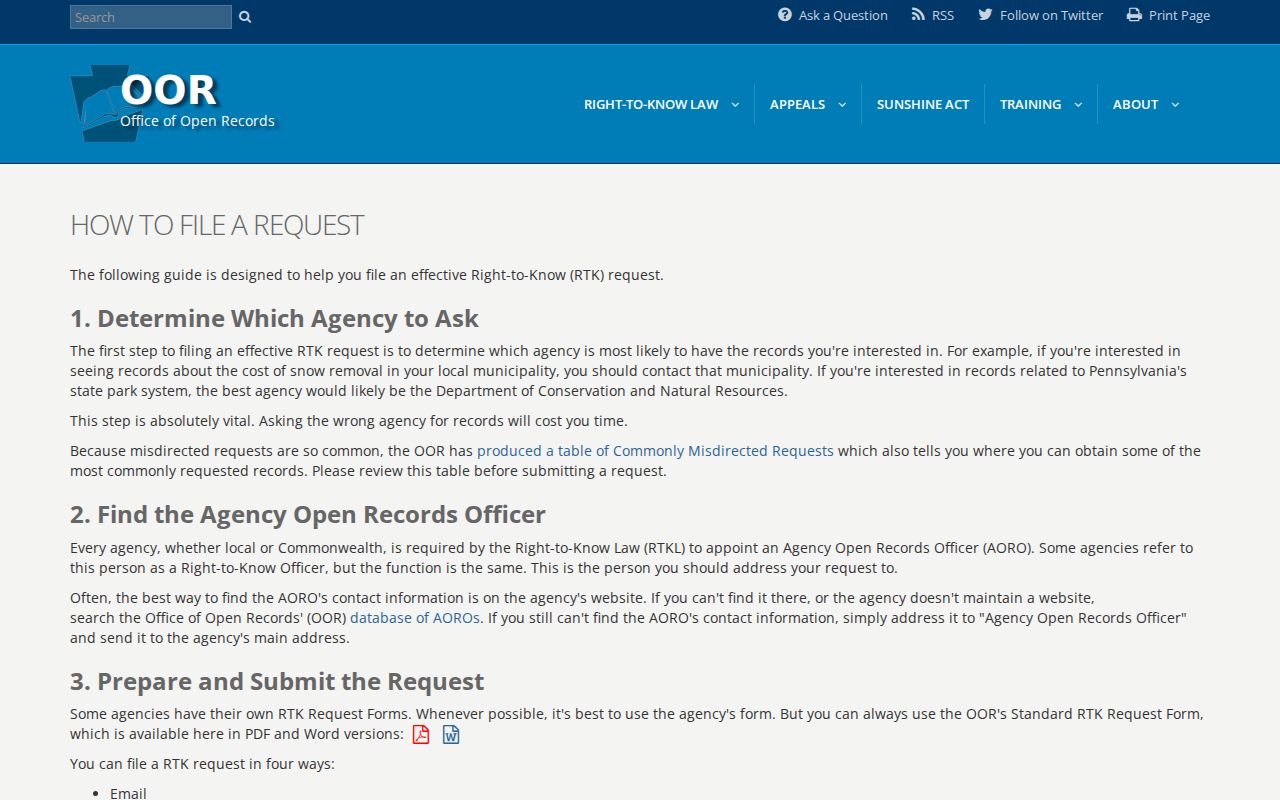
The access guidance is useful when a county executive record exists but the online search does not expose it. It does not change the separate rules for courts, vital records, voter files, or protected addresses.
Allegheny Deed Names Across Time
After an address produces a parcel, land records can supply a dated ownership trail. The official quick search accepts a grantor or grantee name, subdivision, document type, or document number, plus a recorded-date range. It also has an Index Only choice and an Index & Full Text OCR choice. The county says two or more terms behave differently under those scopes, so record the scope used when a search result matters.
The current direct land portal documents an index from 1986 to the present, imaged deeds from 1976 to the present, imaged mortgages from 1986 to the present, and subdivision plans for all years. Its oldest online deed book is 3680. For an older deed, the Department of Real Estate counter, copy service, State Archives, or a library collection may be the actual access channel.
Allegheny County’s court-records page identifies the public divisions that operate alongside, rather than inside, the deed index.
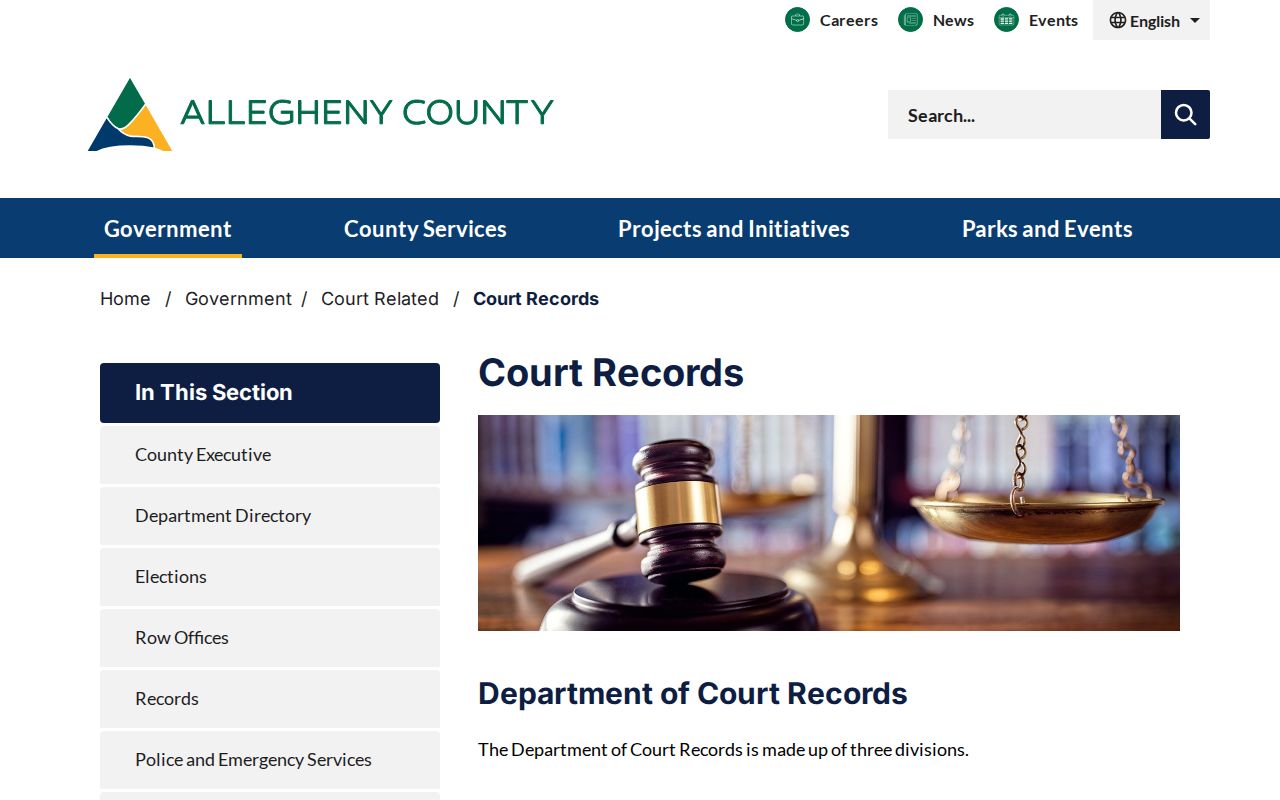
The court-record access page is a reminder that land documents and court files have different custodians, search paths, and confidentiality rules.
Allegheny Court Dockets by Person
The statewide Pennsylvania UJS public service is useful when a person is connected to a public criminal, Magisterial District, appellate, or Philadelphia Municipal docket. In Participant Name mode, choose Allegheny County and use the least amount of identifying information needed. The results can show a docket number, court system, case caption, and a docket-sheet link. Keep all of those fields together before deciding whether a result belongs to the person sought.
UJS is not the public source for ordinary Common Pleas civil docket sheets, and it excludes juvenile, sealed, expunged, pending-expungement, limited-access, and destroyed material. Allegheny Civil/Family and Wills/Orphans questions instead follow the Department of Court Records route, including public terminals and older written-docket access where applicable.
Allegheny County Jail’s inmate-information page documents the official contact and process channel.
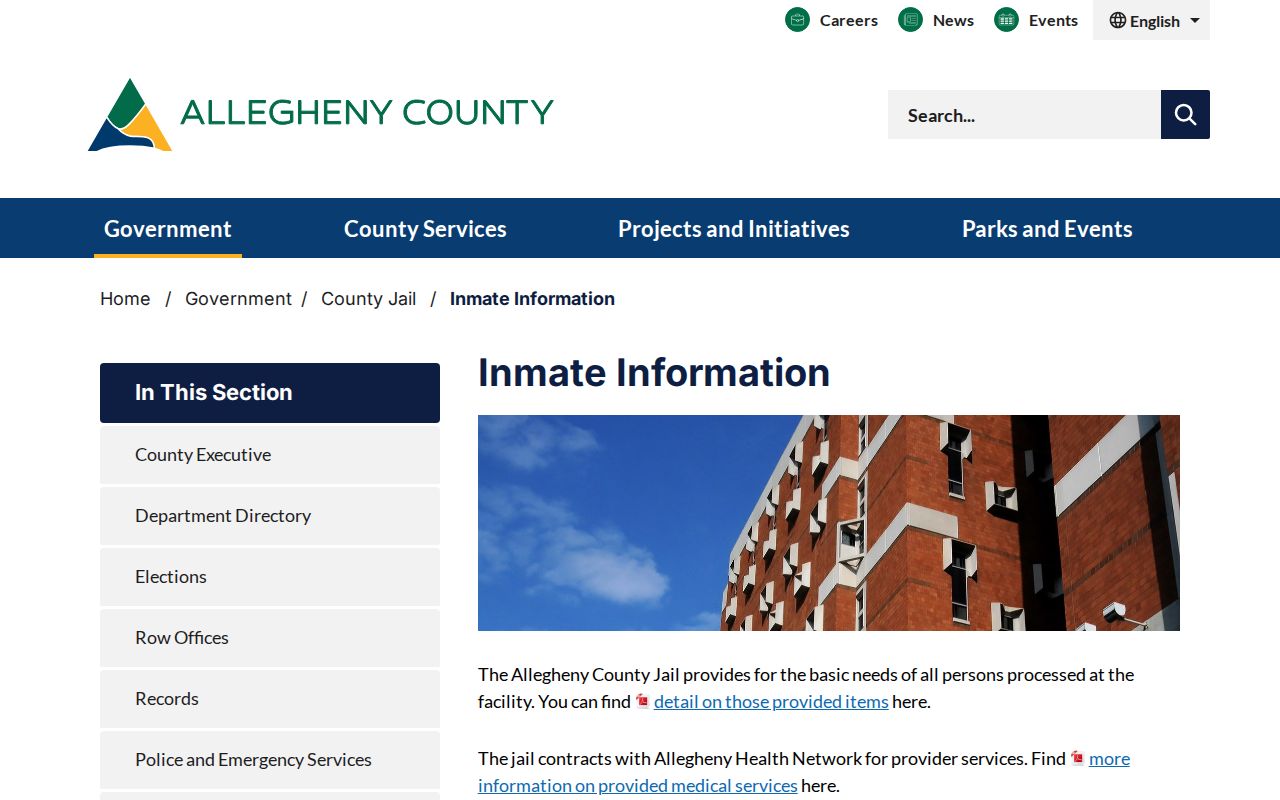
County jail information is a contact and process channel because the reviewed County page did not provide a public roster search. A jail contact is not proof of custody.
Allegheny Vital Record Boundaries
Vital records are not a general name directory. Pennsylvania’s Division of Vital Records issues birth and death certificates, while Allegheny Wills/Orphans keeps original marriage licenses. Under the Vital Statistics Law of 1953, birth records become public after 105 years and death records after 50 years. The Department of Health directs historic index research to PHMC and the State Archives, while certification follows separate eligibility and application rules.
Allegheny marriage licenses from 1885 forward are open for viewing. The County describes 1996-forward online search and ordering, with an earlier-record order route. A plain noncertified copy is $4, and an earlier-record search carries the same $4 charge even when no record is found. That is a focused historical and family-record channel, not a broad present-residence search.
Current Allegheny County Resident Sources
Current sources are best treated as separate Allegheny resident records, not as interchangeable lists. The property search can associate an assessed owner with one parcel. A deed index identifies people in a recorded transaction. A public court docket identifies a party in a case. The state voter status form is designed for a voter to confirm their own registration. Each source has a different date, purpose, and privacy boundary.
| Allegheny source | What it can establish | Custodian | Access path |
|---|---|---|---|
| Real Estate Portal | Assessed owner, parcel, situs, municipality | County assessment system | Address or parcel search |
| Official Record Search | Recorded grantor, grantee, instrument, and date | Department of Real Estate | Public index, copy options |
| UJS docket search | Party, docket number, court, caption, event history | Pennsylvania courts | Public dockets within exclusions |
| Voter-status route | A voter’s own registration status and polling route | Pennsylvania Department of State | Individual status form |
| Historic directories | Printed name, address, occupation in an edition | Library and archival partners | Online volumes and microfilm |
For a question about one person, retain the specific fields that distinguish a same-name result: a full name or initial, source date, municipality, parcel or legal description, and court or docket number. The Allegheny resident lookup workflow applies that cross-checking discipline without turning an administrative record into proof of a present household.
Allegheny Voter Status Limits
Pennsylvania’s Check My Registration service is an individual status and polling-place route. It is not a public tool for browsing people along an Allegheny street. The formal voter-list request process is different. It offers defined Public Information, Street, Walking, and Full Voter Export list choices, and the requester must provide the certification required by the Election Code.
A properly obtained list can have administrative fields such as name, address, party, active or inactive status, and voting history. It never reveals ballot choices. Registration status is also not a finding about where a person is spending each day. Keep a list’s request date and permitted use with any limited research note.
Pennsylvania State Police’s public registry entry point carries the state’s use warning and search access notice.
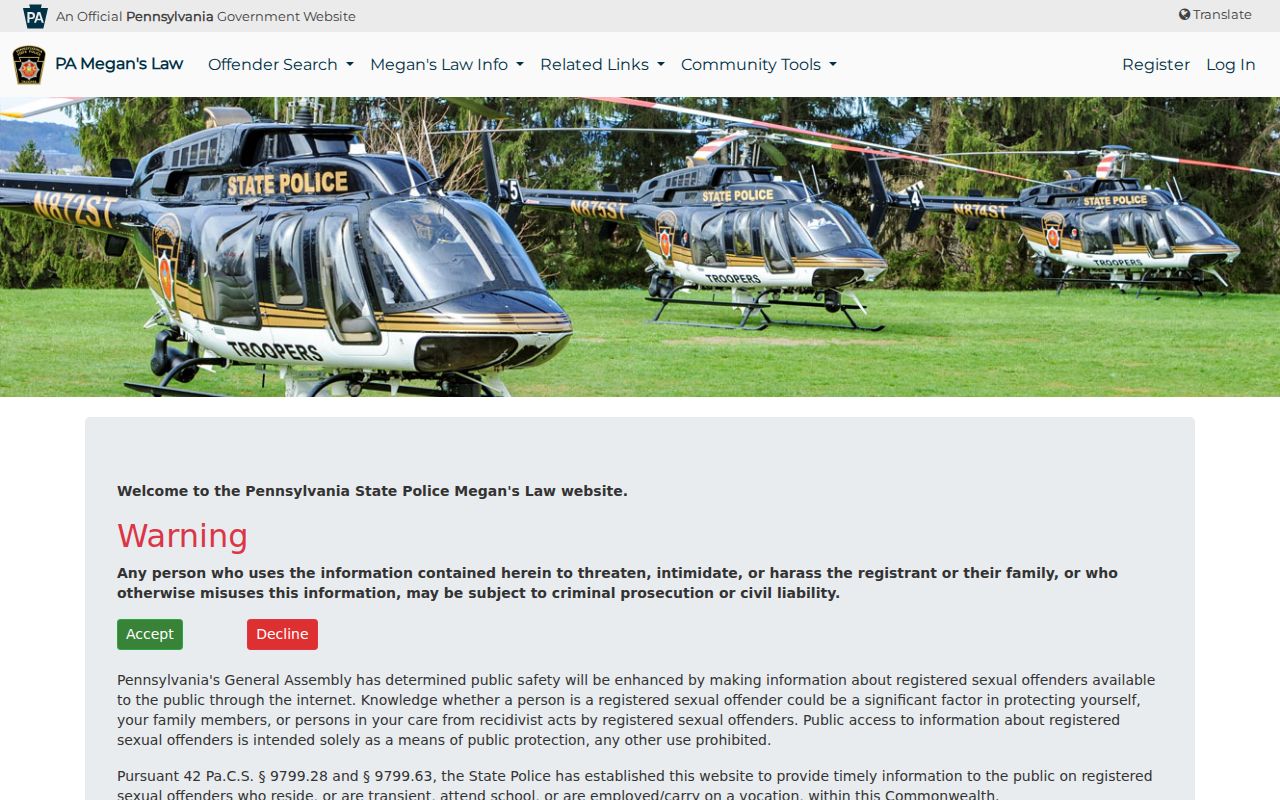
The state registry landing page carries a public-information warning. Like voter and court records, a name result must be handled lawfully and never used to target or harm a person.
Allegheny Privacy and Safer Use
Some expected facts are deliberately unavailable. Pennsylvania’s Address Confidentiality Program gives eligible participants a substitute address, and the program protects applications, actual addresses, and waivers. Court rules also protect categories such as juvenile, adoption, dependency, sealed, and other confidential materials. An absence from an index is not an invitation to search elsewhere for protected information.
When an official record appears wrong, contact the office that maintains it. A court web-docket correction goes to the filing court. Address corrections follow the County’s separate physical, owner-mailing, or tax-mailing processes. The correct route is a custodian correction process, not informal online searching.
Allegheny Records Beyond the Portal
The Pennsylvania Right-to-Know Law, Act 3 of 2008, is a fallback for existing state and local executive-agency records. A written request should identify the agency and the specific record with enough detail to find it. The ordinary response window is five business days, subject to a timely interim response. The Office of Open Records says a request seeks existing records, not a new answer or analysis from staff.
RTKL does not override special confidentiality statutes, voter-file limits, or judicial records rules. Allegheny Court of Common Pleas records follow court channels rather than an ordinary RTKL request. For early county history, the State Archives has a concrete alternative: Allegheny deed indexes and deeds from 1788 to 1871, estate index material from 1788 to 1971, and other probate, naturalization, marriage, and death-register series.
The Office of Open Records filing guidance explains how to choose the proper custodian and officer.
Allegheny County Directory Library Trails
A residents directory search becomes a library search when the date matters more than the current parcel. Historic Pittsburgh has 129 cataloged directory items and a collection whose online volumes include Pittsburgh and Allegheny City material. Carnegie Library of Pittsburgh keeps a longer microfilm trail, including documented directory runs from 1813 through 1975 with gaps. Those two paths complement the county records rather than duplicate them.
The Allegheny County Genealogical Research hub also points readers toward deeds, estates, guardianships, maps, marriage records, libraries, archives, and historical societies. In the Allegheny residents directory context, that is the useful difference between an online result and a complete research plan. A dated library entry should be paired with a map, census, deed, probate record, or another source that matches the same place and era.
Allegheny’s Unusual Historical Records
Allegheny’s research trail reaches well beyond routine property and directory records. County staff found deed-related manumission and indenture material dating from 1792 to 1857, including 49 manumissions and 12 indentures, and transferred it to the Heinz collections. The series illustrates why an old land ledger can contain person records that a current search screen does not describe.
Historic records also have place-name traps. Allegheny City remained separate until Pittsburgh annexed it in 1907, and it is now Pittsburgh’s North Side. A historical directory, map, deed, or municipal record may therefore need both names. The right response to a missing entry is to broaden the dated source set, not to assume the person or address never existed.
Note: Early records should retain the source’s spelling, date, place name, and uncertainty rather than being silently modernized.
Historic Allegheny County Directory Volumes
Historic Pittsburgh is the leading digital start for Allegheny residents in printed directories. Its collection describes J. F. Diffenbacher and R. L. Polk volumes from 1815 to 1945, while its FAQ describes Pittsburgh directories from 1837 to 1930 online with gaps. Carnegie Library of Pittsburgh documents a longer, noncontinuous microfilm run from 1813 to 1975. The volume, place name, and year all matter.
Search historic Allegheny City separately for work that predates Pittsburgh’s 1907 annexation. A printed entry can support a carefully dated address or occupation lead, but not a conclusion about another year. The full collection trail, including library and archive access, belongs in the Allegheny city directory collections.